In this video you see Will at 6 days awake alert and producing continuous cycles of spontaneous movement of the limbs.
As he moves his hands come into contact with the support surface as well as his clothing and his body and face.
Each perceptual-motor cycle produces a rich input of sensory information from the mechanoreceptors,.vestibular receptors and proprioceptors which together provide a sense of his body movement in space and the body relative to the surrounding structures.
Repeated cycles of limb movements allow the infant to start linking particular motor actions to sensory consequences. Changes in the pattern, direction and speed of movements produce different patterns of sensory input.
Linking visual exploration with motor actions
Although at this age the infants motor actions are for the most part spontaneous and not goal oriented, Will is able to intentionally adapt his movements so as to bring his hand within his visual field. To do this he stops moving his limbs and moves his hand into his visual field. (Video at 25:18 s)
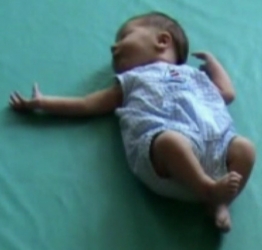

Intentional, goal oriented actions provide the perceptual-motor system with an additional layer of functionality: the intended outcome is compared to the actual outcome, and success can be measured and adaptations to the movement can be made as needed. (Daniela Corbetta has shown how exploration and adaptation is imbedded withing repeated perceptual-action cycles underpins motor learning in infancy.)
Movements of the wrists and fingers
Although the spontaneous movement of newborn infants are characterized by linked flexion and extension movements of the limbs ie hip flexion if associated with knee flexion, individual movements of the fingers and ankles are prominent. The presence of these isolated wrist, finger and ankle movement may be associated with the extensive experience of using the hands and feet to explore the environment starting in utero.
Video: Will at 6 days
Bibliography
Corbetta D, DiMercurio A, Wiener RF, Connell JP, Clark M. (2018) How Perception and Action Fosters Exploration and Selection in Infant Skill Acquisition. Adv Child Dev Behav. 55:1-29. doi: 10.1016/bs.acdb.2018.04.001. Review. PubMed PMID: 30031432.
Corbetta, D., Thurman, S. L., Wiener, R. F., Guan, Y., & Williams, J. L. (2014). Mapping the feel of the arm with the sight of the object: on the embodied origins of infant reaching. Frontiers in psychology, 5, 576. doi:10.3389/fpsyg.2014.00576
For subscribers
Notes on infant development: Supine: Will at 5 days