Stepping down in context
Situations that involve stepping down include:
- Walking towards and stepping down a single step such as a curb, and then continuing to walk forwards.
- Approaching and walking down a flight of stairs, and then continuing to walk on. This is usually achieved using a step-over-step pattern with the trailing leg being placed on the next step.
- Walking down steps of which are wide and require a decision about taking an intermediate step on each step.
Visual pickup for walking down steps and stairs
- Looking ahead when walking towards a step, allows the individual to adjust the length of the preceding steps so that the foot is planted just before the edge of a step.
- Briefly looking down to just before step descent to gather information about step height to adjust motor plan.
- Using peripheral visual to guide each step when going down a flight of stairs.
Stepping down a single step
Stepping down from a single step involves:
- Transferring weight onto one leg - the trailing LL
- Lifting the other foot (of the leading LL) forwards to clear the edge of the step
- At the same time flexing the trailing LL to lower the CoM in a controlled manner
- Reaching down with the leading LL until weight can be transferred to it
- Transferring weight onto the leading LL – with an initial flexion movement at the knee to absorb momentum
- Lifting the trailing LL and placing the foot on the supporting surface.- the exact location will depend on whether the individual plans to walk forwards after descending the step, which is the usual case in everyday activities.
Analysis of kinematic features of stepping down a single step
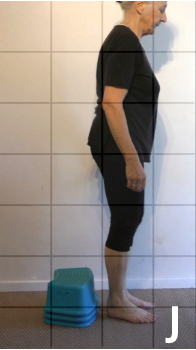
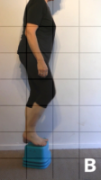
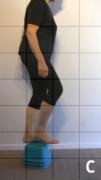
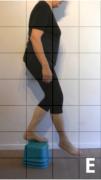
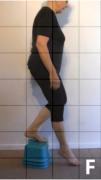
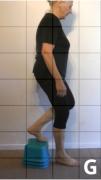
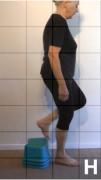
The series of frames below illustrates the coordination between limb action and movement of the CoM when stepping down. The model is a late middle age female.
A-B Weight is transferred towards the stance LL as the foot of the swing LL is lifted off the supporting surface.
At the same time the stance leg has started to flex.
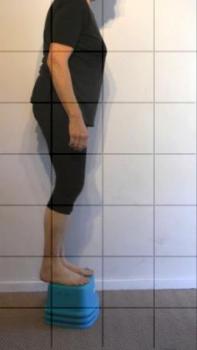

C-D The swing foot is lifted forwards to clear the front edge of the step. The CoM has started to move forwards.
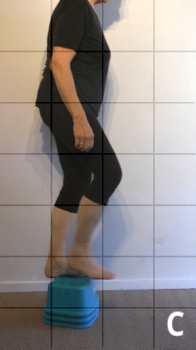

E-F Lowering the CoM
E The stance knee continues to flex as the heel is lifted off the supporting surface and the weight is shifted onto the forefoot. The CoM is moving forwards and downwards.
F The swing LL is preparing for loading. The knee is relatively extended with the foot in plantar flexion


G-H Double leg stance
G The knee of the trailing LL continues to flex reaching a maximum of about 90 degrees .
H As the CoM moves forwards and downwards the load is transferred to the leading leg. The knee flexes to absorb the to absorb the momentum of the downward moving CoM.

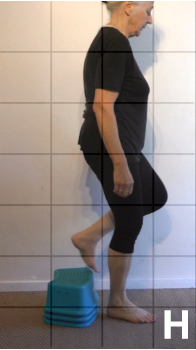
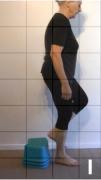
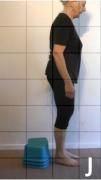
I – L The weight is transferred to the leading leg as the CoM continued to move forwards.
The knee of the new stance LL extends.
The hip of the trailing LL flexes to bring the foot in line with the stance LL and the foot is lowered to the ground.

Analysis of muscle action
Leading lower limb
Hip flexion with knee flexion moves the foot forwards and clear of the step:
- hip flexors - concentric contraction to lift thigh
- knee flexors - maintain knee flexion to allow for foot clearance
- ankle dorsiflexors - maintain dorsiflexion (static contraction)
Knee of swing LL starts to extend in preparation for landing.
- Hip flexion: iliopsoas and rectus femoris
- Knee extension: quadriceps muscles
Preparation for weight transference
- Stabilizing the knee in readiness for accepting the full weight of the body - rapid isometric contraction of the quadriceps and the hamstring muscles (co-contraction)
Transfer of weight onto leading leg associated with slight flexion of the knee
- Hip extensors and abductors work to stabilize the pelvis on the now weight-bearing leading LL
- Knee extensors work eccentrically to control knee flexion, followed by concentric work to extend the knee.
- Ankle dorsiflexors work to stabilize the shank on the foot.
Trailing lower limb
Weight transfer onto trailing LL - single limb stance
- Hip extensors(hamstrings) and abductors contract to stabilise the pelvis
- Knee extensors (quadricceps) work to stabilise the knee.
Knee flexion lowers the body
- Hip extensors and abductors work to stabilize the pelvis on the LL
- Knee extensors work eccentrically to control knee flexion.
Lifting the trailing LL forwards and placing the foot on the floor
- Hip flexors work concentrically to move thigh forwards then eccentrically to lower the foot to the floor.
- Knee flexors maintain knee flexion until the foot is clear of the step, then eccentrically to allow the knee to extend as the foot is lowered to the floor.
- Ankle dorsiflexors work to maintain the ankle in dorsiflexion.