This is the first in a series of three articles in response to a question posed by Mindy: Why do kids bunny hop? See also:
What abilities are needed for reciprocal crawling
Infants who bunny hop need to acquire more variable patterns of movement
In a Wired on Development Facebook post Mindy Silva asked the following question: Why do kids bunny hop?
Mindy goes on as follows: "So a post on another group page got me thinking about all the different components you might want to address for a child who is bunny hopping." Mindy provides a list of possible components that need to be addressed.
My immediate response was: No, no, no! The adoption of a bilateral hip and knee flexion pattern (bunny hopping) reflects the infant's best solution to the challenge of moving forwards in prone kneeling given the available movement resources.
So back to Mindy's question: Why do kids bunny hop?
Working, as I do, from a dynamic systems, constraints led approach to movement analysis and intervention, I decided that I first needed to review how a typically developing infant learns to transition to prone kneeling and then adopt a reciprocal crawling pattern.
The answer to this question is not surprising. Infants explore many possible options for achieving their goals. And variability in their actions allows them to discover the most efficient ways to achieve their goals.
This principle is nicely illustrated in the video clip below which shows Will at 7 months exploring different options for maintaining balance in prone kneeling, as he attempts to lift one hand to play with a toy.
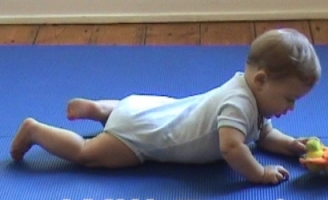

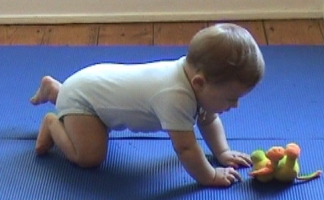

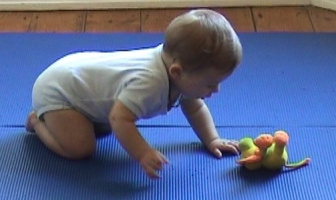


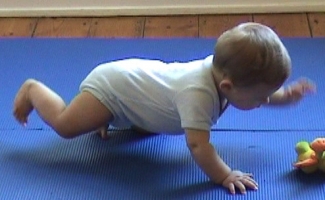
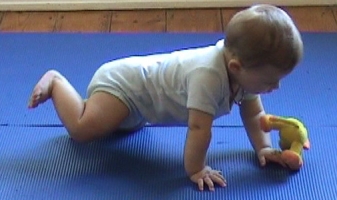
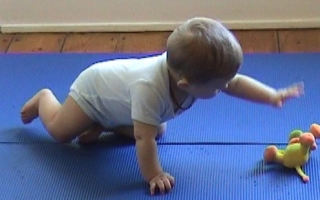
Video clip: Will exploring options for balancing in prone kneeling
Return to Up onto knees and learning to crawl