In this clip you see Max (aged 2 years) playing a game of skittles.He employs a range of well coordinated movement strategies for several different goal directed actions.
You see that Max:
- Understands and participates with a social partner in a ball game that lasts several minutes
- Understands the structure and demands of a throwing task
- Is able to coordinate the UE actions (reaching, throwing, placing) with stepping to move (translate) the body forwards
- Uses different strategies for throwing the ball - each of which challenges balance adaptations in a different way.
Understands the structure of a throwing task
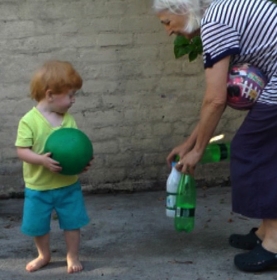
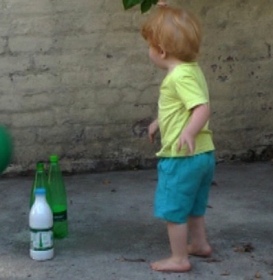
You see Max watching me as I position the bottles.
He understands the game and the structure of a throwing task: he turns to face the bottles in readiness for throwing the ball and waits until I have finished putting the bottles in place.
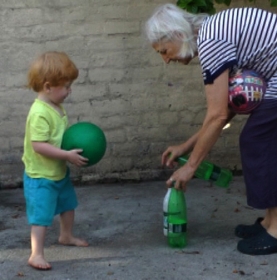
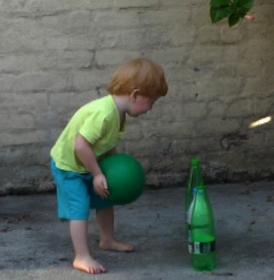
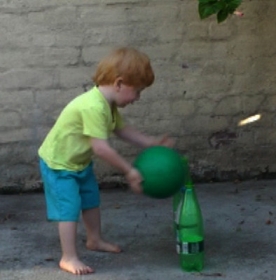
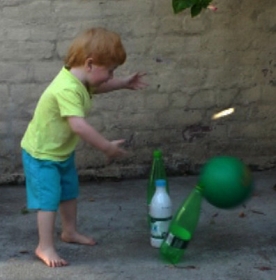
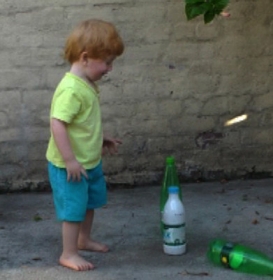
Bilateral underarm throw from a standing start
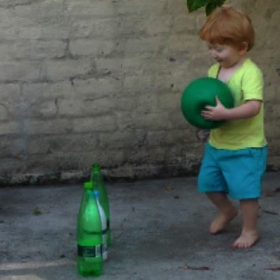
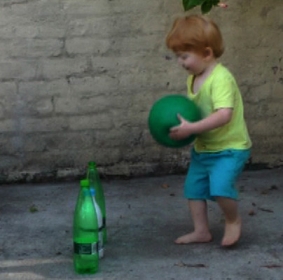
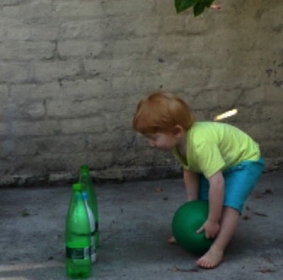
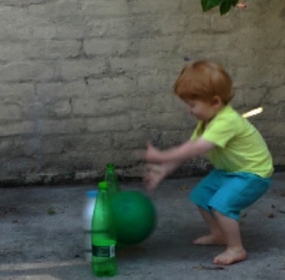
In this sequence you see Max using a bilateral underarm throwing strategy. He moves the left foot sideways to increase the size of the base, tilts the trunk forwards to align the ball with the skittles, moves the hands forwards and releases at the right moment, with UE follow through.
The throwing action tips him forwards over his feet, but he manages to regain his balance.
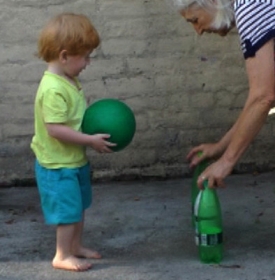
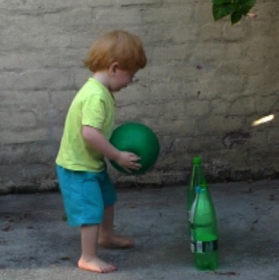
Step and roll the ball
In this next series you see Max step forwards and roll the ball towards the skittles.
Notice how at the beginning of the throwing action his knees are extended and his trunk tipped well forwards to maintain his balance. As he accelerates the UE forwards, he flexes his knees and translates the CoM forwards to maintain his balance and counteract the perturbation caused by the rapid forward movement of the UEs.
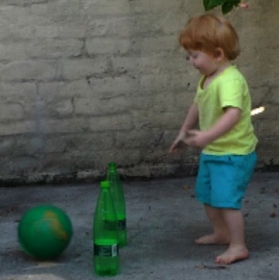
Side arm throw
The variability and exploration of different ways to achieve a goal seen in typically developing toddlers, are seen as Max uses several different throwing strategies to knock down the skittles: a bilateral underarm throw, rolling the ball and in this sequence a side arm throw, which is less successful.
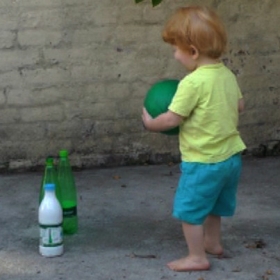
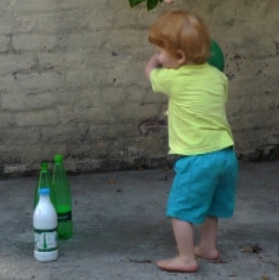
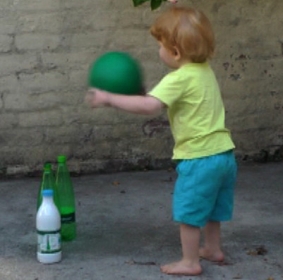
Putting a bottle back in the line
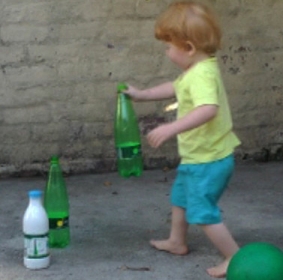
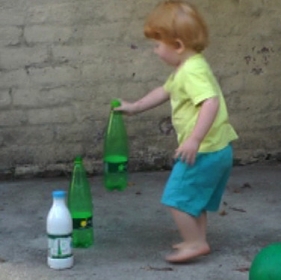
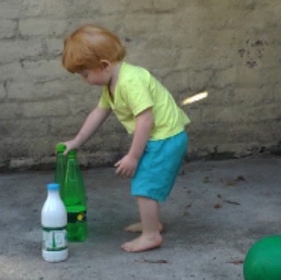
Several other aspects of the sophisticated coordination between the child, the task and the environment in pursuit of a goal are also beautifully illustrated in the video clip.
This sequence of frames shows how Max steps forwards to position a bottle next to the others. He reaches forwards with his right hand as he steps forwards, positions his feet to provide a stable BoS and then tilts the trunk forwards just enough to lower the bottle to the ground.
Reaching forward to grasp a ball
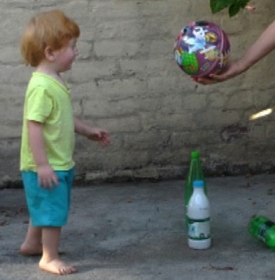
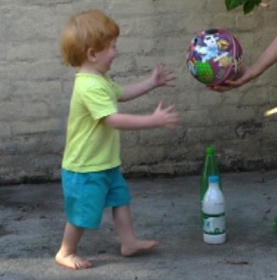
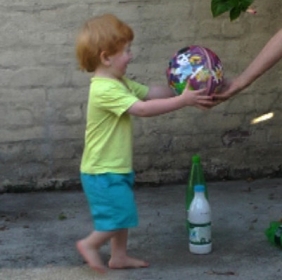
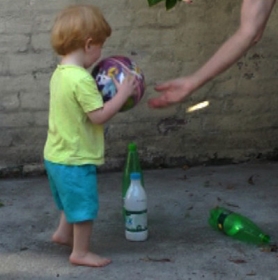
Max also coordinates the stepping actions of the LEs with the reaching actions of the UEs when reaching for the ball - he takes several steps to move closer to the ball and at the same time reaches out with the hands, so that the hands close on the ball at exactly the right place.
To do this he needs to pick up visual information about the position of the ball relative to himself (based on external egocentric coordinates) and translate this information into a series of motor commands (based on internal coordinates).
Max playing skittles
