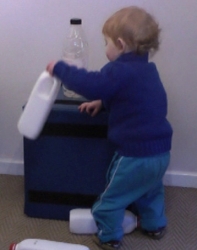
Once infants have learned to balance in standing on can improve their balance as well as limb and trunk strength by initiating games that encourage lifting and moving large and heavy objects.
Moving plastic bottles
One of my favorite toys is a box of plastic bottles of different sizes partially filled with water to give them some weight. Infants seem to enjoy the challenge of moving large and heavy objects. Unpacking and packing away are favorite activities from the age of 10-12 months

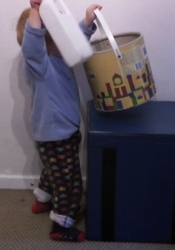
The pictures below show how the infant is able to adapt his actions to provide a more stable BOS for lifting a heavy bottle, including leaning against the foam block to allow him to lift the bottle high enough to get it into the tub.
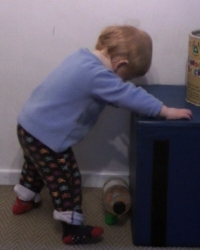
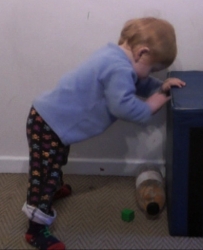
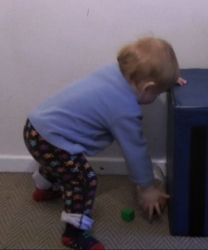
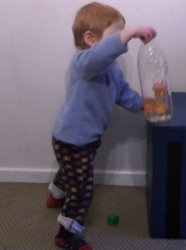
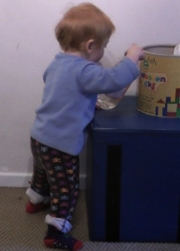
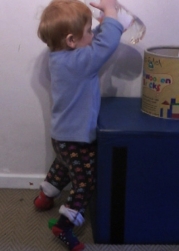
Video clip: Max moving bottles
Building and knocking down towers
Another of my favorite toys is a set of large plastic tubs. These are good for building towers that can be knocked down. From about 12 months infants also like to build their own towers.
Building a tower involves finely graded movement of the arm which in turn depends on having a stable head and trunk. This stability is provided by anticipatory postural responses in the neck as well as adjustments in the alignment of the trunk over the LE to compensate for shifts in the relative position of the COM within the trunk as the arm is lifted forwards.
Throwing balls and bottles
In this next clip you see max throwing tennis balls nd bottles. Maintaining head and trunk stability when throwing requires effective anticipatory postural responses to counteract the forces created by the fast moving throwing arm.
In this play session Max lifts, throws and drops balls and bottles. each of these actions requires a different set of anticipatory and adaptive postural responses in order to maintain head and trunk stability abd balance.
Throwing a ball involves a rapid arm movement with a period of acceleration followed by deceleration (follow through). The adaptive postural responses also need to take account of Max turning his head to watch where the ball goes.
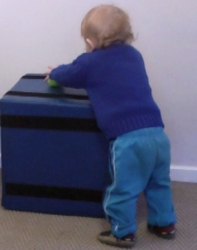
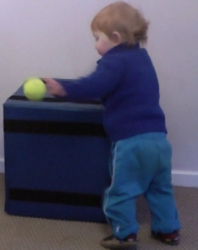
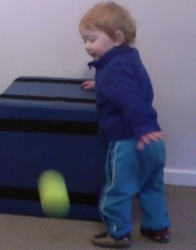
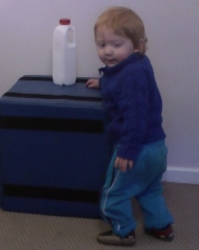
Throwing a plastic bottle half filled with water requires a different set of responses.
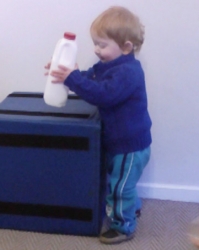
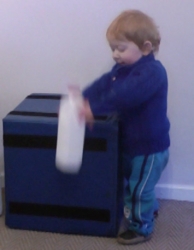
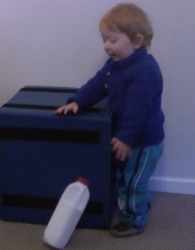
Picking up and moving a heavy bottle, from the floor onto the block requires additional trunk stabilization to support the heavy work being done by the shoulder.