For infants who by the age of 7-8 months have not developed the ability to maintain the trunk erect and balanced on the pelvis, even when provided with some support around the waist or pelvis, an effective way to start sitting training is to use foam blocks to provide just enough support to allow the infant to sit erect, maintain balance and start to reach in different directions.
This approach has the advantage that it allows the infant to explore the surrounding physical environment, find ways to use the surfaces to provide support and change the size and reshape the base of support using the upper limbs in contact with surrounding surfaces.

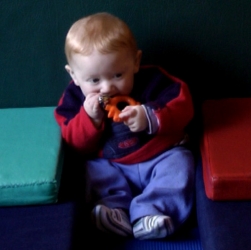
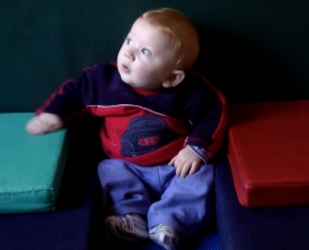
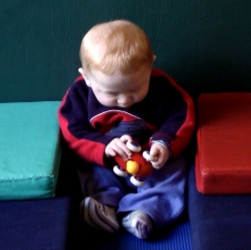
The infant is provided with a support behind the back to prevent falling backwards. Two foam blocks are positioned on either side of the infant, close enough tp the pelvis and thighs to provide some lateral support.
The height of the side blocks will determine how the infant uses these lateral surface for support - either by resting the upper arms on the blocks, or on the forearms and hands if the surface is lower.
Setting up the sitting environment
Let the infant sit with the back towards a vertical surface that supports the trunk effectively.
Position a foam block on each side of the child so that it provides lateral support of the pelvis and trunk, reaching up to mid thoracic level.
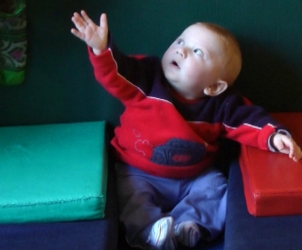
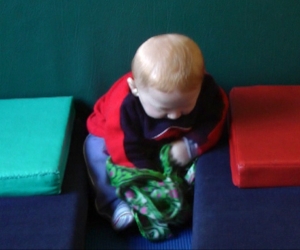
Encourage the infant to rest the upper arms on the blocks to provide additional support for maintaining trunk extension.

The next step is to engage the infants attention so that he/she is motivated to keep the head erect and steady.
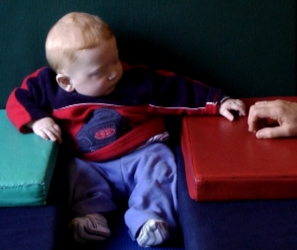
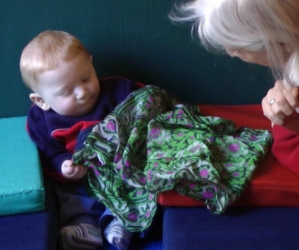
Face-to-face engagement with reciprocal social interaction that is fun and keeps the child's attention is one of the bast ways to keep the infant alert and actively engaged in looking and responding.
Peek-a-boo, singing and tickle games are all good social ways to keep the infant alert and active.
Max takes particular delight in playing with a scarf. Playing peek-a-boo and reaching for the tangled scarf get him alert and active.

Encourage the infant to reach for toys
Once the infant is able to sustain a more-or-less erect posture, the next step is to encourage the infant to reach for toys.
Position a few toys so that the infant needs to reach out to grasp them.
Start by placing the toys so that the infant can easily grab the toy - and as the infant's confidence and control improve, move the toys a little further away so that reaching disturbs the infant's balance and he needs to adapt the trunk and limb configuration to stay erect.

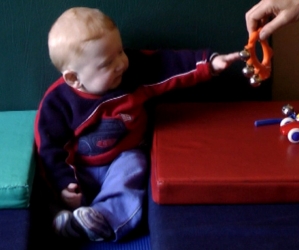
With practice the infant should start to make use of the available stable surfaces to aid his efforts to stay erect, or recover from a movement that causes him to loose his balance.
Video: Max 9m sitting between foam blocks